

Supervisor: Dr. Isabelle GROSS
Overview
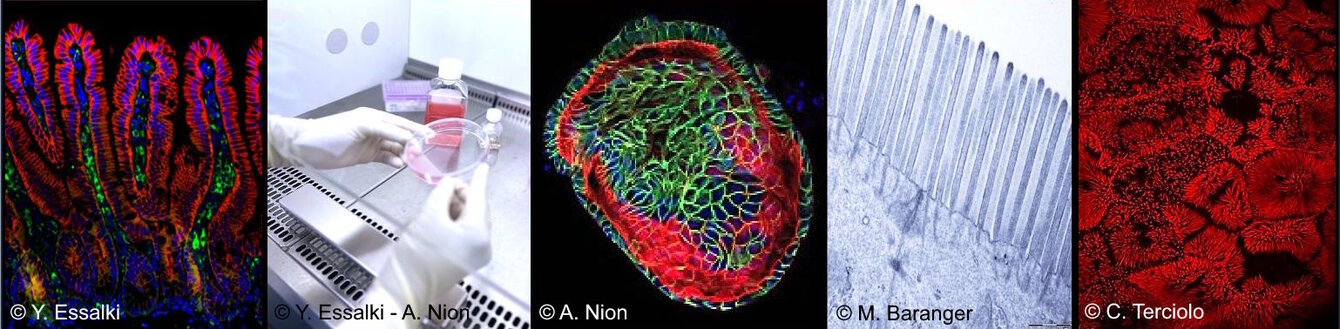
The intestinal epithelium is composed of various specialized cell types that form a selective barrier and perform essential digestive functions, in close interaction with the microbiota, the immune system and the enteric nervous system.
It is also the most rapidly renewing tissue in adults, thanks to the presence of intestinal stem cells and the coordinated action of numerous signaling pathways that regulate the balance between proliferation, differentiation and apoptosis. However, environmental factors, lifestyle, genetics and aging can disrupt this equilibrium, leading to serious intestinal epithelial pathologies such as chronic inflammatory bowel diseases (IBD) and/or colorectal cancer (CRC).
Objectives
The goal of our research is to better understand the mechanisms that maintain intestinal epithelial homeostasis to improve the prevention, diagnosis and treatment of CRC, as well as IBD. We aim to decipher and recapitulate — using relevant study models — the reciprocal interactions between intestinal epithelial cells and their environment, in order to identify and test original therapeutic solutions. Several complementary research axes are being developed in parallel:
Fundamental research axis: This focuses on characterizing the importance of the morphological and functional properties of intestinal epithelial cells for acquiring and maintaining their identity, their interactions with the microenvironment and intestinal tissue homeostasis. This is achieved, in particular through the study of the atypical cadherin MUCDHL, whose expression is crucial for the properties of differentiated intestinal epithelial cells and is lost in CRC/IBD.
Translational research axis: This aims to develop innovative preclinical models, such as "Gut-on-Chip", which demonstrate individual heterogeneity and microenvironment concepts by establishing immunocompetent, innervated and vascularized organoids derived from patients (MITI2 project).
Applied research axis: This focuses on using human "Gut-on-Chip" organoids as preclinical models to conduct therapeutic efficacy tests, as well as pharmacological and environmental toxicity tests (e.g. pollutants, food additives, dysbiosis).
Scientific expertise
Molecular and cellular biology
Gastroenterology
Intestinal physiopathology
Cadherins
Transcriptional and post-translational regulation
Technical expertise
Models for intestinal studies: 2D/3D cell lines, organoids, murine models of CRC & IBD
Targeted gain/loss-of-function approaches: plasmids, siRNA, activators, inhibitors
In vitro (insert) and in vivo intestinal permeability testing
Toxicity, proliferation and viability assays in 2D and 3D
Immunostaining: tissue sections, whole-mount
Imaging: confocal, spinning disk, Incucyte live-cell microscopy
Mechanisms of action of therapeutic molecules:
Gene expression (RT-qPCR, Western blot, omics, ELISA)
Transcriptional activity (ChIP, luciferase reporter assays)
Protein interactions (co-immunoprecipitation, PLA)
Signal transduction