

Objectives
The fundamental, pre-clinical and clinical research activities are in the field of rare diseases and integrated in a translational and multi-disciplinary approach between UMR 1260 and the Reference Center for Oral and Dental Rare Diseases O-RARES (University Hospital Strasbourg). One of the experimental objectives is the development and in vivo characterization of different bioengineering strategies for the treatment of jaw bone defect, based on synthetic electrospunned tridimensional scaffolds or bone substitutes. Another purpose is a better understanding of jaw bone response to surgical trauma and implant osteointegration, using experimental mouse models of bone lesion or intra-oral micro-implant. Genetically modified mice, models of rare diseases with dento-cranio-facial phenotypes (Wnt10a -/- cre-lox knock-out for example) are also studied for a better understanding of bone metabolism and regeneration in pathological conditions.
Public health and epidemiology of dental status and habits are also studied, as well as the use of bone substitutes and different techniques of bone grafting in their ethical and medico-economic aspects. A part of our research activities focuses on the safety of care while treating bone and teeth oral pathologies, especially when dealing with hygiene and public health issues. The objectives are to improve the safety of care, to anchor laboratory projects in a medico-economic reality of efficiency, and to act as a public health observatory for bone and oral pathologies.
Main results and perspectives
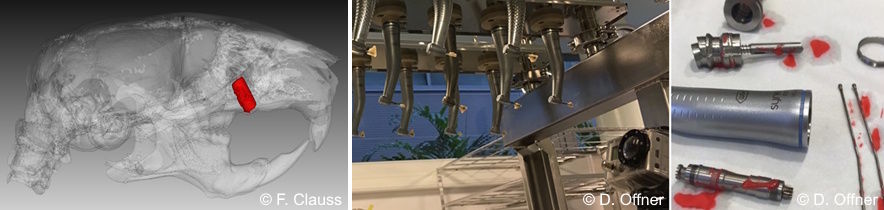
We could demonstrate on a mouse model of maxillary alveolar jaw bone lesion the positive effects on bone neoformation of osteogenic BMP2 factors and human bone marrow mesenchymal stem cells associated (hBM-MSC) in polycaprolactone (PCL) biomembrane (Stutz et al., 2020). Viability of hBM-MSCs on the biomembranes has been confirmed and maxillary bone regeneration was observed during 90 to 150 days after implantation by in vivo micro-CT showing bone remodeling and filling of the lesion by neoformed bone tissue. The presence of hBM-MSC and BMP-2 allows the acceleration of the bone remodeling process, which is interesting for a future clinical use in healthy patients or patients presenting genetic developmental anomalies of jaw and teeth. One of the perspective is to evaluated this kind of strategy in other genetically modified mouse models, for exemple knock-out models for Eda, Fam20A or Pthr1 genes.
We could demonstrate the effect of a Smoc2 homozygous mutation on bone regeneration in a mouse model of maxillary extraction, with an increased osteoclastic activity and bone remodelling and a partial reversion based on a COX2 inhibitor systemic administration (Morkmued et al., 2020). We could bring also the proof of concept concerning the interest and potential of a mouse model of intra-oral micro-implant, allowing the ultra-structural studies (SR-micro-CT, nano-CT) of peri-implant bone neoformation and implant osteointegration physiology and complications. The micro-implant can be placed in different types of genetically modified mouse models, with a great interest in the field or rare diseases,
Concerning the ethical aspects of bone grafting, we highlighted a very good acceptance for the management of bone defects using the products of regenerative medicine, the latter reaching thus biological and humanist quality standards (Offner et al., 2019). Our work focusing on the effectiveness of nonsurgical interventions in the treatment of patients with knee osteoarthritis, using various strategies including bone substitutes, showed that the use of platelet-rich-plasma (PRP) and MSC are promising strategies (Naja et al., 2021). In regards of the safety of care, we developed procedures and evaluation methods which improve the (re)processing of medical devices, particularly dynamic oral instruments or handpieces and dental units (Offner et al., 2020, Offner & Musset 2021, Fruhauf et al., 2024) and investigated the epidemic and post-epidemic dental emergency typology and hygiene habits in dental practices (Broyer et al., 2023 ; Fernandez de Grado et al., 2023). Finally, we showed that there is an improvment in the tooth brushing frequency in French adolescent, and we drew hypotheses to extract associated factors (Fernandez de Grado et al., 2021).
Our perspectives are to carry out a medico-economic evaluation (cost-utility) of osteoarthritis treatment strategies based on a Markov decision-model, and of regenerative medicine strategies coupled with a clinical trial ; and to strengthen our position as a public health observatory for bone and oral pathologies, with an upcoming national epidemiological study about the dental status of children and adolescents in France, after the local one published in 2025 (Offner et al., 2025).
Publications
Stutz, C. et al. A New Polycaprolactone-Based Biomembrane Functionalized with BMP-2 and Stem Cells Improves Maxillary Bone Regeneration. Nanomaterials10, 1774 (2020). https://doi.org/10.3390/nano10091774
Offner, D. et al. Bone Grafts, Bone Substitutes and Regenerative Medicine Acceptance for the Management of Bone Defects Among French Population: Issues about Ethics, Religion or Fear? Cell Medicine11, 2155179019857661 (2019). https://doi.org/10.1177/2155179019857661
Morkmued, S. et al. Deficiency of the SMOC2 matricellular protein impairs bone healing and produces age-dependent bone loss. Scientific Reports10, 14817 (2020). https://doi.org/10.1038/s41598-020-71749-6
Naja, M. et al. Comparative effectiveness of nonsurgical interventions in the treatment of patients with knee osteoarthritis: A PRISMA-compliant systematic review and network meta-analysis. Medicine100, e28067 (2021). https://doi.org/10.1097/MD.0000000000028067
Offner, D. et al. Mobile Dental Delivery System: An Effective Protocol for Hygiene and Disinfection. International Journal of Environmental Research and Public Health17, 1603 (2020). https://doi.org/10.3390/ijerph17051603
Offner, D. & Musset, A.-M. An Evaluation of Two Systems for the Management of the Microbiological Quality of Water in Dental Unit Waterlines: Hygowater® and IGN Calbénium®. International Journal of Environmental Research and Public Health18, 5477 (2021). https://doi.org/10.3390/ijerph18105477
Fruhauf, A., Fernandez De Grado, G., Scholler, J. & Offner, D. Compliance of the Dryness of Dental Handpieces for Their Sterilization under Various Treatment Conditions. Hygiene 4, 231–237 (2024). https://doi.org/10.3390/hygiene4020019
Broyer, C., Fernandez De Grado, G. & Offner, D. The “new normal” of hygiene measures at the end of the COVID-19 epidemic: a survey among French dentists. BMC Health Services Research23, 1199 (2023). https://doi.org/10.1186/s12913-023-10167-6
Fernandez De Grado, G., Villerey, G., Musset, A.-M. & Offner, D. Oral emergencies at Strasbourg teaching hospitals during the COVID-19 lockdown: Patient care circuits, typologies, and profiles. Sante Publique35, 35–44 (2023). https://doi.org/10.3917/spub.hs1.2023.0035
Fernandez De Grado, G. et al. Changes in tooth brushing frequency and its associated factors from 2006 to 2014 among French adolescents: Results from three repeated cross sectional HBSC studies. PLOS ONE16, e0249129 (2021). https://doi.org/10.1371/journal.pone.0249129
Offner, D. et al. Oral Health Status of Children in Strasbourg: An Epidemiological Study (2018–2022). Children13, (2025). https://doi.org/10.3390/children13010004