

Overview
Our Team “GP-SMIT” has a long-standing expertise in the study of the molecular causes of the frequent resistance of gastric cancers towards the standard treatment protocol and the development of new therapeutic strategies. We are developing research that is voluntarily translational and interdisciplinary by bringing together biologists, digestive surgeons, oncologists and chemists.
Our main projects are: SECMIC and INNOTHER.
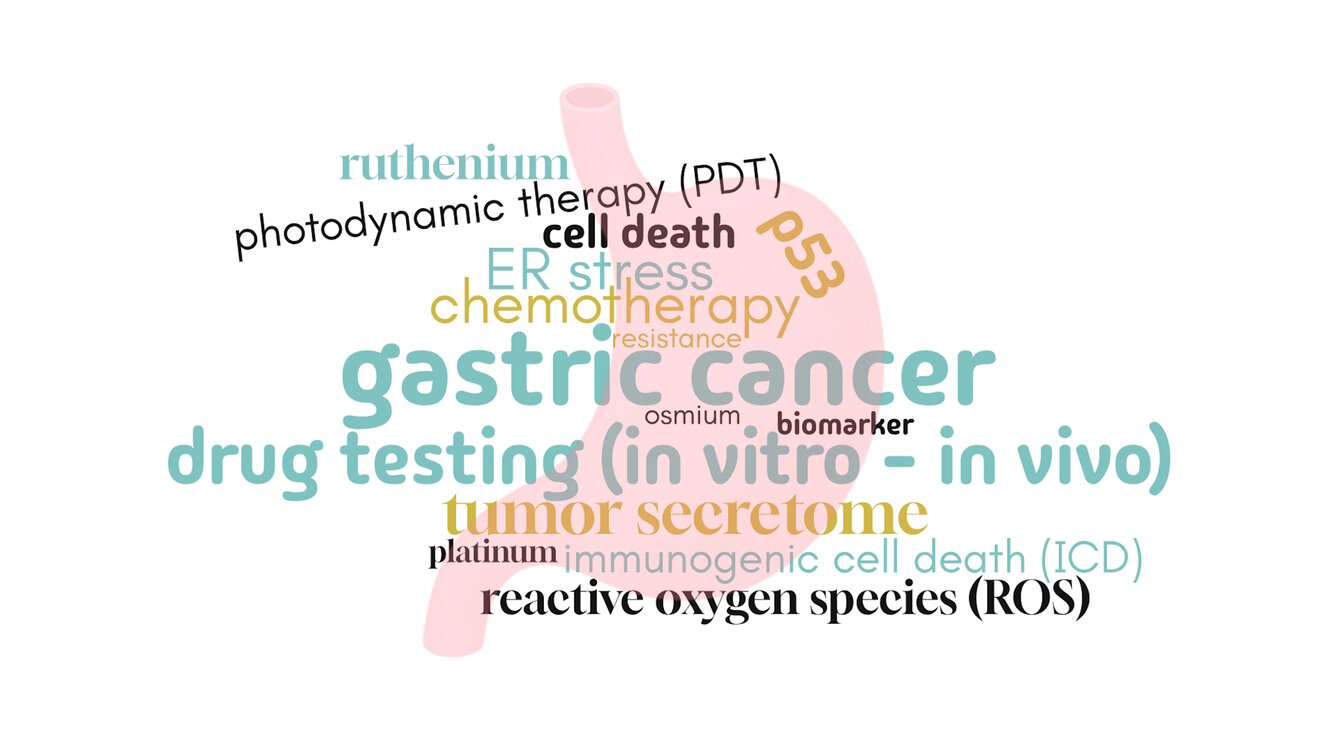
- SECMIC aims to explore the impact of chemotherapies on the secretome of gastric cancer cells and how it drives the identity of the tumour micro- (CAFs, immune cells…) and macro-environments (muscle, enteric nervous system).
- INNOTHER project is dedicated to developing photosensitisers (PS) based on transition metals (ruthenium, osmium) for photodynamic therapy (PDT) drugs, enabling non-invasive, localized treatment of gastric cancer.
Expertise
The team has extensive expertise in various molecular and cellular biology techniques used to study the molecular mechanisms that determine the therapeutic response and aggressiveness of gastric cancers (GC). It has developed multiple GC-patient-derived xenograft (PDX) mouse models, established a syngeneic GC mouse model, and assembled a comprehensive collection of human GC cell lines with varying p53 mutational status and histological subtypes.
It also has well-established collaborations with clinicians at the University Hospital in Strasbourg and with chemists at national and international institutions to develop and characterize the in vitro and in vivo anticancer activity of novel compounds.
Publications
Thibaudeau, C. et al. Inverse Correlation between Endoplasmic Reticulum Stress Intensity and Antitumor Immune Response with Ruthenium(II)-Based Photosensitizers for the Photodynamic Therapy of Head and Neck Squamous Cell Carcinoma. J. Med. Chem.68, 25126–25142 (2025). https://doi.org/10.1021/acs.jmedchem.5c02147
Kwan, K. et al.Evaluation of dual-function molecules containing both Zn-Ionophore and aggregation inhibition moieties for mutant p53 protein reactivation. Journal of Inorganic Biochemistry 113088 (2025). https://doi.org/10.1016/j.jinorgbio.2025.113088
Restrepo-Acevedo, A. et al. Protoporphyrin IX-Derived Ruthenium(II) Complexes for Photodynamic Therapy in Gastric Cancer Cells. Inorg. Chem.64, 9684–9702 (2025). https://doi.org/10.1021/acs.inorgchem.5c00896
Scarpi-Luttenauer, M. et al. Platinum( ii ) and ruthenium( ii ) coordination complexes equipped with an anchoring site for binding the protein kinase enzyme pockets: synthesis, molecular docking and biological assays. Dalton Transactions54, 8270–8286 (2025). https://doi.org/10.1039/D4DT02984D
Riegel, G. et al. The unfolded protein response-glutathione metabolism axis: A novel target of a cycloruthenated complexes bypassing tumor resistance mechanisms. Cancer Letters585, 216671 (2024). https://doi.org/10.1016/j.canlet.2024.216671
Kwan, K. et al. Altering relative metal-binding affinities in multifunctional Metallochaperones for mutant p53 reactivation. Journal of Inorganic Biochemistry251, 112433 (2024). https://doi.org/10.1016/j.jinorgbio.2023.112433
Mourtada, J. et al. A novel ΔNp63-dependent immune mechanism improves prognosis of HPV-related head and neck cancer. Front. Immunol.14, (2023). https://doi.org/10.3389/fimmu.2023.1264093
Miller, J. J. et al. Multifunctional metallochaperone modifications for targeting subsite cavities in mutant p53-Y220C. Journal of Inorganic Biochemistry242, 112164 (2023). https://doi.org/10.1016/j.jinorgbio.2023.112164
Venkatasamy, A. et al. Morpho-functional analysis of patient-derived xenografts reveals differential impact of gastric cancer and chemotherapy on the tumor ecosystem, affecting immune check point, metabolism, and sarcopenia. Gastric Cancer26, 220–233 (2023). https://doi.org/10.1007/s10120-022-01359-w
Badie, A., Gaiddon, C. & Mellitzer, G. Histone Deacetylase Functions in Gastric Cancer: Therapeutic Target? Cancers14, 5472 (2022). https://doi.org/10.3390/cancers14215472
De Azevedo, J. et al. The EXTREME Regimen Associating Cetuximab and Cisplatin Favors Head and Neck Cancer Cell Death and Immunogenicity with the Induction of an Anti-Cancer Immune Response. Cells11, 2866 (2022). https://doi.org/10.3390/cells11182866
Venkatasamy, A. et al. Ultrasound and Transcriptomics Identify a Differential Impact of Cisplatin and Histone Deacetylation on Tumor Structure and Microenvironment in a Patient-Derived In Vivo Model of Gastric Cancer. Pharmaceutics13, 1485 (2021). https://doi.org/10.3390/pharmaceutics13091485